- Licensed Bhutanese tour operator
- Thimphu, Bhutan

Bhutan destinations · Updated October 2026
Phobjikha Valley, Bhutan: travel guide for 2027
A wide glacial valley where black-necked cranes spend the winter. Gangtey Goemba on its hill, a gentle nature trail and some of the most peaceful nights in Bhutan.
- About 3,000 m
- Cranes late October to February
- Crane Festival 11 November 2027
3,000 m
Altitude of the valley, approximately
609
Cranes counted in Phobjikha in the 2023 to 2024 season
1613
Year Gangtey Goemba was founded
3 h
Drive from Punakha
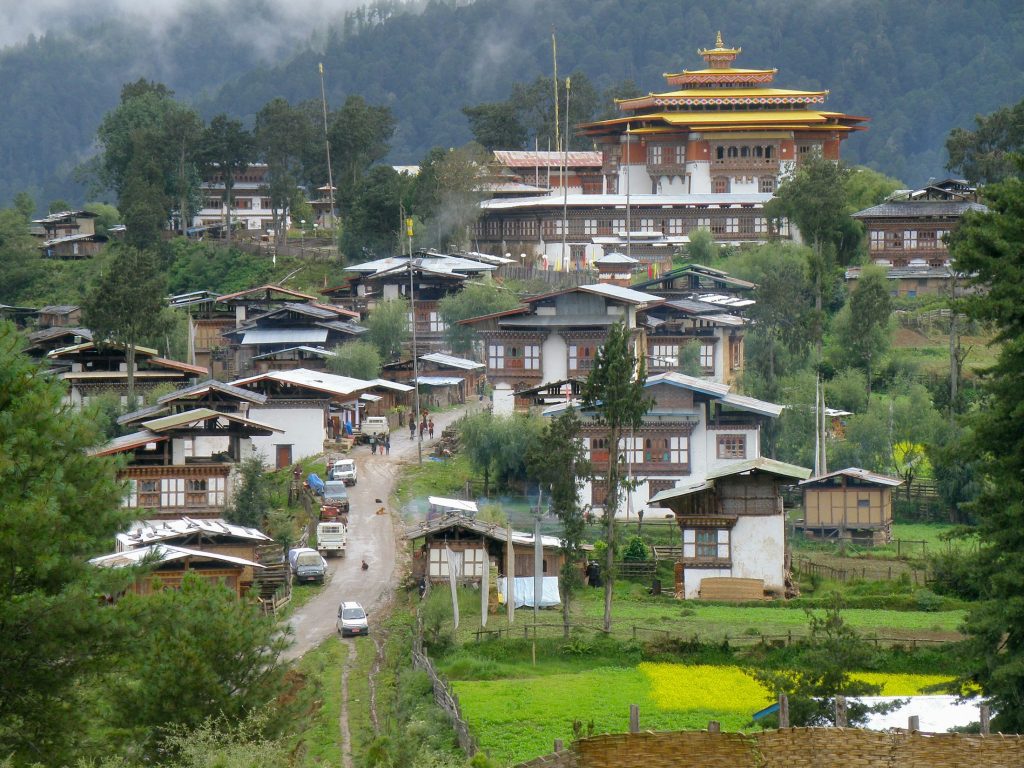
About Phobjikha
The crane valley
Phobjikha is a broad, bowl-shaped valley on the western edge of the Black Mountains, at around 3,000 metres. Its marshy floor is the most important wintering ground in Bhutan for the black-necked crane, a vulnerable species that breeds on the Tibetan plateau. The cranes arrive from late October and leave around February or March. Local people say they circle Gangtey Goemba three times when they arrive and again when they leave.
The valley is protected as the Gangtey-Phobji Ramsar site, about 975 hectares of wetland, and conservation work is led by the Royal Society for Protection of Nature. To keep the cranes safe, the valley’s electricity runs through underground cables rather than overhead lines. Farmers grow potatoes on the slopes, and in the evening the only sounds are the river and the cranes calling.
- Bhutan's main black-necked crane habitat
- A protected Ramsar wetland
- Cold, clear nights and wood stoves
Things to do
Top things to do in Phobjikha
Watch the cranes
From the valley floor or the information centre, late October to February.
Gangtey Goemba
A 17th-century monastery of the Pema Lingpa tradition, restored in 2008.
Crane Information Centre
Telescopes, exhibits and RSPN's conservation story.
Gangtey nature trail
An easy 1.5 to 2 hour walk through pine forest and meadows.
Black-necked Crane Festival
Children dance in crane costumes at Gangtey Goemba each 11 November.
Farmhouse stay
A night with a farming family and a hot stone bath.
Longtey hike
A half-day walk over a ridge from the Pele La road into the valley.
Gangtey Tshechu
A small autumn festival in the monastery courtyard.
Cycling
Quiet farm tracks around the valley floor.
In detail
Phobjikha in detail
The black-necked cranes
The Royal Society for Protection of Nature counted 676 cranes across Bhutan in the 2023 to 2024 winter, up 12 per cent on the year before, and 609 of them were in Phobjikha. The rest winter in Bumdeling in the east and a handful in Khotokha and Tang. The best viewing is early morning and late afternoon, when the birds feed in the open. Keep your distance, stay quiet, and never fly a drone; drones need approval from the Bhutan Civil Aviation Authority in any case.
Gangtey Goemba
Gangtey Goemba was founded in 1613 by Pema Thinley, grandson of the treasure revealer Pema Lingpa. It is the main seat of the Pema Lingpa tradition in western Bhutan and the home of the Gangteng Tulku. A major restoration ran from 2002 to 2008, and the monastery was reconsecrated on 10 October 2008. Look out for its huge wooden pillars and the view down the valley from the courtyard.
The Gangtey nature trail
This gentle walk starts near the monastery and drops through pine forest and open meadows to the valley floor, ending near Khewang Lhakhang. It takes about 1.5 to 2 hours and suits most fitness levels. In crane season you often see the birds from the trail.
Festivals
The Black-necked Crane Festival is held every year on 11 November in the courtyard of Gangtey Goemba, with schoolchildren in crane costumes, folk songs and conservation messages. The Gangtey Tshechu is expected on 13 to 15 October 2027, with a thongdrel shown on the final day.
Practical facts
Phobjikha at a glance
| Topic | What to know |
|---|---|
| Getting there | About 3 hours from Punakha; 5 to 6 hours from Thimphu |
| Drive times | About 3.5 to 4 hours onward to Trongsa over Pele La |
| Altitude | About 2,900 to 3,000 m |
| Crane season | Late October to February, sometimes into early March |
| Weather | Cold nights all year and below freezing in winter; bring warm layers |
| Time needed | 1 to 2 nights |
| Where to stay | Farmhouse homestays, small lodges, and luxury stays such as Amankora Gangtey and Six Senses Gangtey |
| Festivals 2027 | Gangtey Tshechu 13 to 15 October; Black-necked Crane Festival 11 November (tentative) |
Planning
When and how to visit
For cranes, come between November and February. November combines the Crane Festival with clear autumn weather; December and January are colder but very quiet. In spring and early autumn the valley is green and good for walking, though the cranes are gone. Most trips reach Phobjikha from Punakha and continue to Trongsa and Bumthang, or return west.
Tours
Tours that include this destination
Every tour is private and can be changed. These are starting points.
10 Day Discover Bhutan
West and central Bhutan, including Phobjikha and Bumthang.
12 Day Birdwatching
From the western valleys to the forests of central Bhutan.
10 Days with Jakar Tshechu
Bumthang’s autumn festival with Trongsa and Phobjikha.
Before you go
Travel essentials for 2027
Every visitor except Indian, Bangladeshi and Maldivian nationals needs a visa, which costs USD 40 and is arranged by your tour operator. The Sustainable Development Fee is USD 100 per adult per night until 31 August 2027; children under 6 pay nothing and children aged 6 to 12 pay half. Indian visitors pay INR 1,200 per night. You travel with a licensed guide beyond the first checkpoint and stay in certified hotels or homestays.
Read more in our guides to the visa and SDF, what a trip costs and Bhutan’s travel rules.
Phobjikha: questions
From late October to February, mainly in the Phobjikha valley.
In the 2023 to 2024 winter, 609 were counted in Phobjikha out of 676 in Bhutan.
Every year on 11 November at Gangtey Goemba.
Gangtey is the monastery and village on the ridge; Phobjikha is the valley below. Both names are used for the area.
One or two nights. Two gives you time for the nature trail and crane watching at dawn and dusk.
Yes, especially at night and in winter, when it falls below freezing.
Plan your time in Phobjikha
Tell us your dates and how many nights you have. We will send a day-by-day plan with named hotels and one price that includes the SDF, visa, guide and car.
Photo credits, via Wikimedia Commons: Wangdue Phodrang countryside (Gerd Eichmann, CC BY-SA 4.0); Trongsa Dzong (Gerd Eichmann, CC BY-SA 4.0).
