- Licensed Bhutanese tour operator
- Thimphu, Bhutan

Bhutan destinations · Updated October 2026
Trongsa, Bhutan: travel guide for 2027
The heart of Bhutan, both on the map and in history. The country’s largest dzong, the tower museum above it and the road where the Wangchuck kings rose to power.
- About 2,200 m
- Largest dzong in Bhutan
- Halfway between west and east
1647
Year Trongsa Dzong was founded
2,200 m
Altitude of the dzong, approximately
68 km
Road distance to Jakar in Bumthang
2008
Year the Ta Dzong museum opened
About Trongsa
Where the kings of Bhutan began
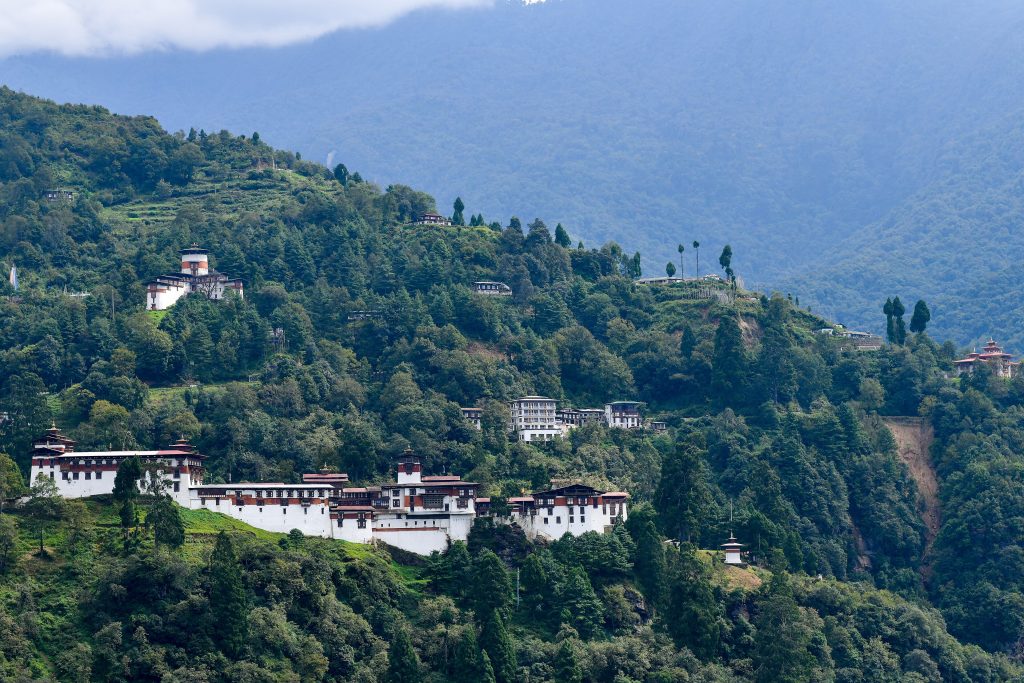
Trongsa sits in the centre of the country, on a ridge high above the Mangde Chhu gorge. For centuries every traveller between east and west had to pass through its dzong, which gave its governors, the Trongsa Penlops, great power. In 1907 the Penlop Ugyen Wangchuck was crowned the first King of Bhutan. The tradition continues today: the crown prince is invested as Trongsa Penlop before he takes the throne.
The first view of the dzong comes long before you arrive, across the gorge from the road. Its town is small, with a few hotels and shops along one street. Most visitors stop for a half day between Phobjikha and Bumthang, but a night here lets you see the dzong in the evening light without hurrying.
- Seat of the Wangchuck dynasty
- On Bhutan's UNESCO tentative list
- A natural break on the road to Bumthang
Things to do
Top things to do in Trongsa
Trongsa Dzong
Chhoekhor Rabtentse Dzong, a maze of courtyards and more than 20 temples.
Royal Heritage Museum
In the Ta Dzong watchtower, telling the story of the monarchy.
Chendebji Chorten
A white stupa in Nepalese style on the road from Pele La.
Pele La
The pass from the west, at about 3,400 m.
The dzong viewpoint
The classic view across the gorge before you reach town.
Trongsa Tshechu
A winter festival in the dzong courtyards, usually in December.
In detail
Trongsa in detail
Trongsa Dzong
A small temple was built here in 1543 by the lama Ngagi Wangchuk. In 1647 Zhabdrung Ngawang Namgyel began the dzong, named Chhoekhor Rabtentse, and it was enlarged in 1652 and many times after. The 1897 earthquake damaged it badly; it was restored, and it was reconsecrated in 2004 after a major renovation. The dzong steps down the ridge in a series of courtyards and houses a printing house for religious texts. It is the largest dzong in Bhutan and is on the country’s UNESCO tentative list.
Ta Dzong and the Royal Heritage Museum
Above the dzong stands the Ta Dzong, a watchtower that once guarded the route. Since 2008 it has housed a museum about the Wangchuck dynasty, with personal belongings of the kings, religious objects and the story of how Trongsa’s governors unified the country. Allow an hour, and climb to the top floor for the view down onto the dzong roofs.
Chendebji Chorten
On the road from Pele La, about 40 km before Trongsa, this large white chorten is modelled on the Swayambhunath stupa in Kathmandu, with painted eyes facing the four directions. It is a good place to stretch your legs on the long drive.
The Trongsa Tshechu
Trongsa’s main festival is held in the dzong in winter, usually in December, with a thongdrel on the last day. The 2026 festival is expected on 17 to 21 December; 2027 dates follow the lunar calendar and are confirmed later in the year. In the same month, the Goenpai Drupchen is expected on 3 to 5 December 2027.
Practical facts
Trongsa at a glance
| Topic | What to know |
|---|---|
| Getting there | By road: about 3.5 to 4 hours from Phobjikha, or 5 to 6 hours from Punakha, over Pele La |
| Onward | About 68 km and 2.5 to 3 hours to Jakar in Bumthang over Yotong La; a southern road leads to Zhemgang and Gelephu |
| Altitude | About 2,200 m at the dzong |
| Best time | March to May and late September to November; winter is cold but often clear |
| Time needed | A half-day stop, or one night |
| Where to stay | A handful of hotels with dzong views; many guests continue to Bumthang the same day |
| Festivals | Trongsa Tshechu in December; Goenpai Drupchen 3 to 5 December 2027; Lhamoi Dromchhen 11 to 13 February 2027 (tentative) |
Tours
Tours that include this destination
Every tour is private and can be changed. These are starting points.
10 Day Discover Bhutan
West and central Bhutan, including Phobjikha and Bumthang.
10 Days with Jakar Tshechu
Bumthang’s autumn festival with Trongsa and Phobjikha.
15 Day East to West
Fly east to Yonphula and drive the whole country back to Paro.
Before you go
Travel essentials for 2027
Every visitor except Indian, Bangladeshi and Maldivian nationals needs a visa, which costs USD 40 and is arranged by your tour operator. The Sustainable Development Fee is USD 100 per adult per night until 31 August 2027; children under 6 pay nothing and children aged 6 to 12 pay half. Indian visitors pay INR 1,200 per night. You travel with a licensed guide beyond the first checkpoint and stay in certified hotels or homestays.
Read more in our guides to the visa and SDF, what a trip costs and Bhutan’s travel rules.
Trongsa: questions
Yes. It is generally described as the largest dzong in the country.
Its governors controlled the east-west route, and the Penlop of Trongsa, Ugyen Wangchuck, became the first King in 1907.
About 68 km, or 2.5 to 3 hours by road over Yotong La.
It is optional. A half day covers the dzong and museum, but a night avoids a long driving day.
The Royal Heritage Museum in the Ta Dzong tells the story of the Wangchuck kings, with royal belongings and religious artefacts.
Nearby
Combine it with these places
Plan your time in Trongsa
Tell us your dates and how many nights you have. We will send a day-by-day plan with named hotels and one price that includes the SDF, visa, guide and car.
Photo credits, via Wikimedia Commons: Trongsa Dzong (Gerd Eichmann, CC BY-SA 4.0); Trongsa Dzong from the road (Christopher J. Fynn, CC BY-SA 4.0); Jakar Dzong (Gerd Eichmann, CC BY-SA 4.0); Chendebji Chorten (Arian Zwegers, CC BY 2.0); Wangdue Phodrang countryside (Gerd Eichmann, CC BY-SA 4.0).
