- Licensed Bhutanese tour operator
- Thimphu, Bhutan

Blog · Updated November 2026
Talo Tshechu: a hilltop festival above Punakha
A three-day festival at a monastery high on the ridge above the Punakha valley. Smaller than Paro, closer to village life, and home to a dance you will not see anywhere else.
- Tentatively 16 to 18 March 2027
- About 2,800 m above sea level
- Three days of dances
1767
Talo monastery founded
About 1 hour
Drive from Punakha
3 days
Of masked dances
Zhungdra
A dance found only at Talo
The place
Talo and its monastery
Talo is a village spread along a ridge high above the Punakha valley, at roughly 2,800 metres. The monastery, Talo Goenpa, was founded in 1767 and is closely linked to the line of reincarnations of Zhabdrung Ngawang Namgyal, the founder of the Bhutanese state. Its white buildings look down over terraced fields, pine forest and, far below, the rivers that meet at Punakha Dzong.
The village is known for its neat traditional houses and gardens, and the drive up from the valley floor climbs through farmland with wide views. On a clear spring day you can see across the valley to the hills of Wangdue.
Talo Tshechu is held in the courtyard of the monastery. Because the space is small and the village is off the main tourist route, it feels local and relaxed. Most of the audience are farmers from Talo and nearby villages, together with relatives who have come back from Thimphu and elsewhere for the festival.
- Founded in 1767
- Linked to the Zhabdrung's reincarnations
- A local festival with few visitors
At the festival
What to expect at Talo Tshechu
The masked dances
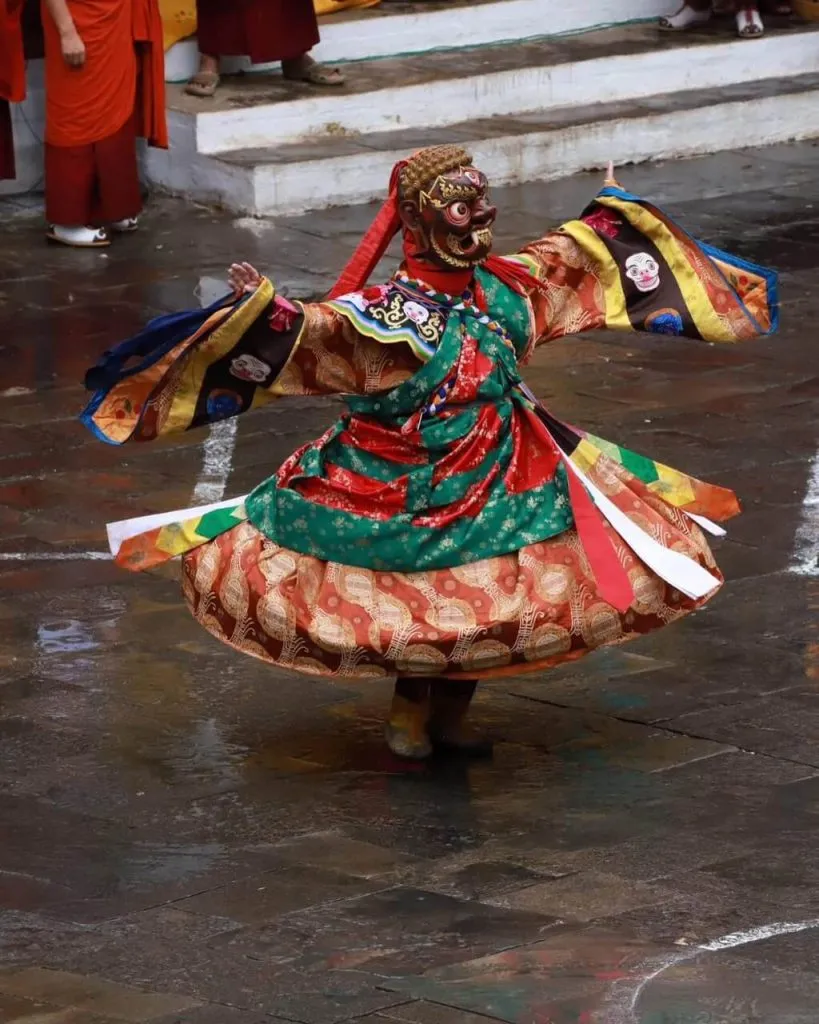
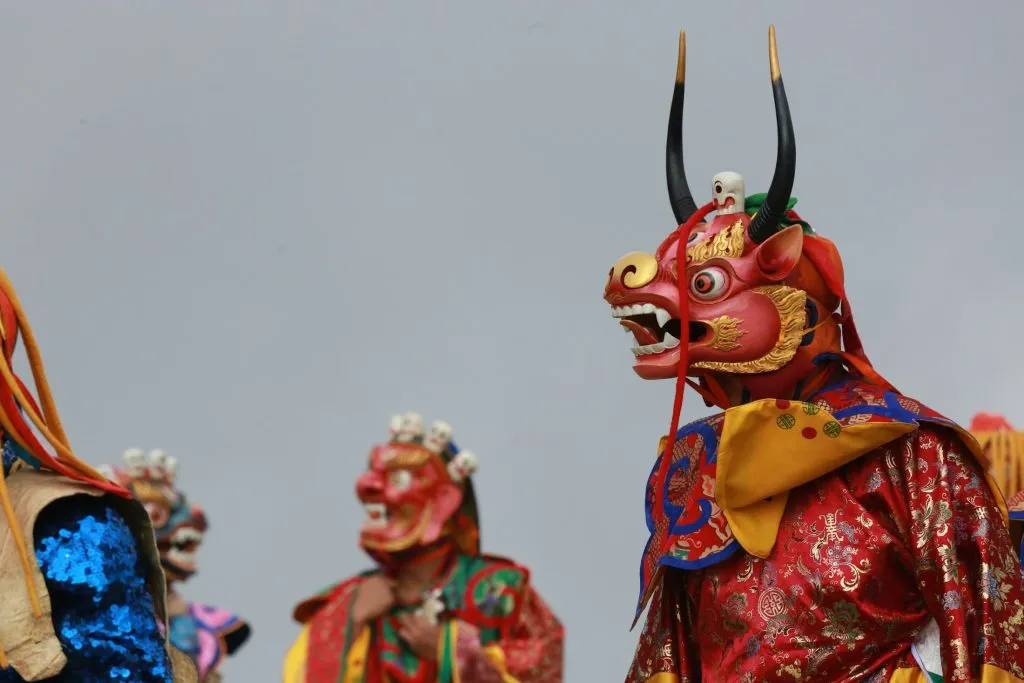
Like every tshechu, Talo’s festival honours Guru Rinpoche. Monks and lay dancers perform cham, sacred masked dances, in the monastery courtyard over three days, accompanied by drums, cymbals and long horns. Some dances bless the ground and drive away harmful forces, others tell stories with a moral meaning. Your guide will explain each one as it happens.
The Zhungdra dance
Talo is best known for a dance that belongs to this festival. It is performed by the Talo dance group, men from the village, and is set to zhungdra, the slow, classical style of Bhutanese folk song. The singing is long and drawn out and the movements are slow and graceful, quite unlike the leaping masked dances. Many Bhutanese consider it one of the finest performances of traditional song and dance in the country.
The Mani Sum songs
Each day of the festival closes with the Mani Sum, songs sung together by the village dancers. It is a moving end to the day, with the light fading over the valley and the whole crowd listening in silence. Stay for it if you can, rather than leaving early to beat the traffic.
The atsaras and the crowd
Between the dances the atsaras, masked clowns, keep the crowd laughing and in order. Families picnic around the edge of the courtyard, children watch from the steps and old people turn prayer wheels. With fewer visitors than at the big festivals, you will find it easier to talk to people and to get a clear view of the dances.
At a glance
Talo Tshechu compared with the big festivals
| Talo Tshechu | Paro or Thimphu Tshechu | |
|---|---|---|
| Size | Small, one monastery courtyard | Large, thousands of people |
| Visitors | Few foreigners | Many foreign visitors |
| Special feature | Zhungdra dance and Mani Sum songs | Thongdrel on the last morning |
| Setting | Ridge-top village above Punakha | Dzong in a valley town |
| Length | Three days | Four or five days |
| Getting there | About an hour's drive from Punakha | In town |
Talo Tshechu’s 2027 dates are the Department of Tourism’s tentative dates. Lunar calendar dates are confirmed closer to the time.
Around Talo
Punakha, the base for the festival
Most visitors stay in Punakha and drive up to Talo each morning. Punakha is lower and warmer than Thimphu, and in March the valley is green, the rice terraces are being prepared and jacaranda trees around the dzong start to bloom.
Punakha Dzong, built in 1637 by the Zhabdrung at the meeting of the Pho Chhu and Mo Chhu rivers, was Bhutan’s capital until the 1950s and is still one of the most beautiful buildings in the country. Visit it on a day when you are not at the festival.
Also nearby are Chimi Lhakhang, the fertility temple of the Divine Madman, reached by a short walk through rice fields, the long Punakha suspension bridge, and Khamsum Yulley Namgyal Chorten, a short hike above the river with views up the valley.
- Stay in Punakha, drive up each day
- Punakha Dzong built in 1637
- Chimi Lhakhang and the suspension bridge nearby
Practical tips
Before you go to Talo
Start early
The road up from the valley is narrow and busy on festival days. Leave Punakha early for a good spot.
Bring a warm layer
Talo is higher and cooler than Punakha. Mornings can be chilly even when the valley is warm.
Dress modestly
Long sleeves and long trousers or skirts. Many visitors wear a gho or kira.
Photograph respectfully
No flash, no stepping onto the dance ground, and ask before close portraits.
Bring water and snacks
There are a few food stalls, but less choice than at the big town festivals.
Bring a cushion
You will sit on stone or grass for hours. A small cushion makes a big difference.
Sample plan
A week with Talo Tshechu
A relaxed spring route through western Bhutan with two days at the festival.
Day 1: Arrive, Thimphu
Land in Paro and drive to Thimphu.
Day 2: To Punakha
Over Dochula pass to Punakha. Visit Punakha Dzong.
Day 3: Talo Tshechu
First day at the festival, staying for the Mani Sum songs.
Day 4: Talo and Chimi Lhakhang
Morning at the festival, afternoon walk to Chimi Lhakhang.
Day 5: Phobjikha or Paro
Continue to Gangtey, or return to Paro.
Day 6: Tiger's Nest
Hike to Paro Taktsang.
Day 7: Depart
Transfer to Paro airport.
Why go
Who Talo Tshechu suits
Talo is a good choice if you want a festival that feels like a village celebration rather than a public event. It suits travellers on a second visit to Bhutan, photographers who want a clear view without crowds, and anyone interested in Bhutanese music, since the Zhungdra dance and Mani Sum songs are rare chances to hear classical folk singing performed in its traditional setting.
It also fits neatly into a classic first trip. Punakha is on almost every itinerary, so adding a day or two at Talo costs little extra time. Because several district festivals fall around the same days in spring, you can sometimes see two different festivals on one trip. Our 2027 festival calendar shows what else is happening that week.
The main drawback is practical. The festival ground is small, the road is narrow and facilities are basic. If you need easy access or want a big, dramatic spectacle, Paro or Punakha Drubchen may suit you better.
Etiquette at a village monastery
At a small festival, visitors stand out more, so good manners matter. Sit where your guide suggests, usually at the edge of the courtyard. Do not walk across the dance ground or between the dancers and the altar. Keep your voice low during the sacred dances, take off hats when entering the temple, and walk clockwise around chortens and the temple building. If someone offers food or a cup of ara, the local spirit, accept with your right hand, or politely decline with a smile.
Music
Zhungdra: the classical song of Bhutan
Bhutanese folk music has two main traditional forms. Zhungdra is the older, home-grown style, which grew up in Bhutan from around the 17th century. Boedra developed later and shows more influence from Tibetan court music. Zhungdra songs are slow, with long, held notes that rise and fall, and the singers often stand in a line or a half circle, moving with small, measured steps.
Hearing zhungdra performed live, in a monastery courtyard by people whose families have sung it for generations, is very different from hearing it on a recording or at a hotel show. The words are often religious or describe the beauty of a place, and older people in the audience will sometimes sing along under their breath.
If you are interested in music, tell your guide in advance. They can help you talk to the singers between performances, and some can translate the meaning of the songs. Our music and cultural arts tour also visits the Royal Academy of Performing Arts in Thimphu, where these traditions are taught.
Photography
Photographing Talo Tshechu
Talo is a rewarding festival for photographers because the setting is so open. The courtyard looks out over the valley, and in the morning the light falls across the dancers from the side. Arrive early to find a spot at the edge of the courtyard where you can shoot without blocking anyone’s view.
A short telephoto lens is ideal, letting you fill the frame with a mask or a costume from a respectful distance. Avoid flash entirely. For crowd scenes, look for families sharing food, monks watching from the balconies and children perched on walls. Always ask before taking close portraits, and be prepared for people to say no.
Remember that photography is not allowed inside the temple itself, and some dances are especially sacred. When your guide tells you to put the camera away, do so.
Beyond the festival
More to see in the Punakha valley in spring
Spring is one of the best times to be in Punakha. The days are warm, often in the mid-20s Celsius, while Thimphu and Paro are still cool. Farmers are ploughing and planting, and the green of the new rice seedlings spreads across the terraces. It is a good time for walks.
Beyond the dzong and Chimi Lhakhang, consider the walk up to Sangchhen Dorji Lhuendrup nunnery, which looks over the valley from a ridge on the other side, or a gentle bike ride along the river road. Rafting on the Mo Chhu or Pho Chhu is popular from March, with calm stretches suitable for beginners.
For something slower, spend an afternoon in a village with your guide, helping in a field or learning to play khuru, the Bhutanese darts game. Many travellers say these unplanned hours are what they remember best.
If you are travelling on to central Bhutan, Punakha is also the gateway to Gangtey and Phobjikha, about three hours’ drive away, and then on over the Pele La pass to Trongsa and Bumthang.
Talo Tshechu: questions
The Department of Tourism’s tentative dates are 16 to 18 March 2027. Dates follow the lunar calendar and are confirmed closer to the time.
Talo is a village on a ridge above the Punakha valley, about an hour’s drive from Punakha town.
Its Zhungdra dance, performed by the village dance group to slow classical song, and the Mani Sum songs that close each day.
No. It is much smaller than Paro or Thimphu Tshechu and has few foreign visitors.
Most visitors stay in Punakha and drive up to Talo each morning.
Often, yes. Several district festivals fall in the same spring weeks. Check our festival calendar or ask us.
It depends on the length of your trip, your hotels and your group size. The government fees are fixed. Tell us your budget and we will send our best price.
Yes. It is narrow and winding, so drivers take it slowly, and our drivers know it well. Expect more traffic than usual on festival days.
Plan a trip around Talo Tshechu
Tell us your dates and interests. We will plan the festival days, the rest of your route and send our best price for your budget.