- Licensed Bhutanese tour operator
- Thimphu, Bhutan
Special interest tour · 9 days, 8 nights
9 Day Bhutan Thangka Painting and Crafts Tour: Learn from Bhutan's Master Painters
Spend two days in a thangka painter’s studio learning to draw and paint by the traditional rules, visit the National Institute for Zorig Chusum, and meet woodcarvers, mask makers and papermakers in Thimphu and Paro.
- 9 days, 8 nights
- Two-day painting workshop
- Thimphu, Punakha and Paro
1971
Painting school that became the national institute
13
Traditional arts
2
Days in a master’s studio
Easy
Grade
Trip overview
Painting by the old rules
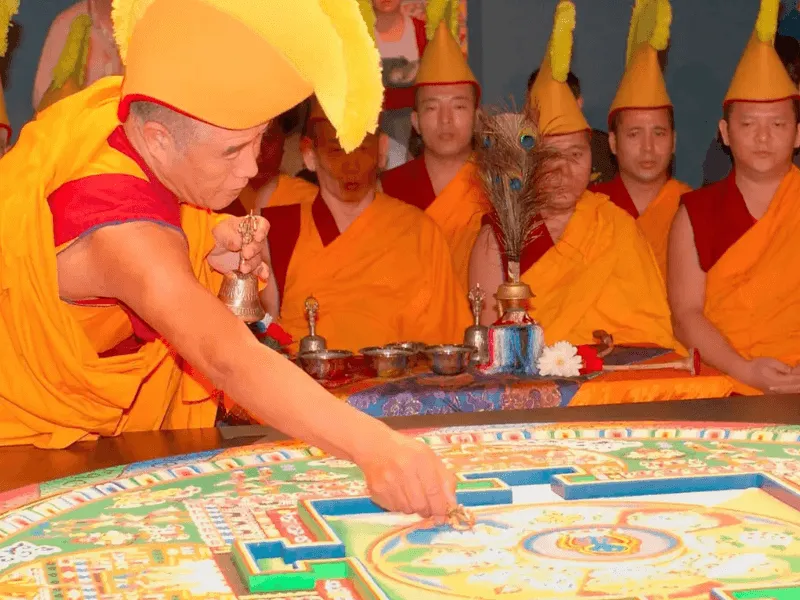
A thangka is a Buddhist painting on cloth, usually showing a deity, a saint or a mandala. In Bhutan they hang in every temple and dzong and in the altar rooms of homes, and the biggest, called thongdrel, are several storeys high and shown only once a year at festivals. Painting is the first of the thirteen traditional arts, the zorig chusum, and it follows strict rules. Each figure is drawn on a grid of fixed proportions, every colour has meaning, and the paints are made from minerals and plants.
This 9 day tour lets you see and try the work for yourself. In Thimphu you visit the National Institute for Zorig Chusum, which began in 1971 as a small painting school and now teaches young Bhutanese all the traditional arts over several years. Then you spend two days in the studio of a professional thangka painter, learning to sketch a Buddha figure on the proportion grid, prepare the canvas, grind and mix pigments, and paint a small piece to take home.
The rest of the trip shows you painting in its setting and introduces other crafts: the murals of Punakha Dzong, the woodcarvers and mask makers of Thimphu, papermaking from daphne bark, and the painted temples of Paro. You finish with the Tiger’s Nest. No experience is needed; the master adjusts the lesson to your level, and experienced artists can go deeper into iconography and technique.
- Two-day thangka workshop with a professional painter
- National Institute for Zorig Chusum
- Woodcarving, mask making and papermaking
Highlights
Highlights of the tour
Thangka workshop
Two days at the easel with a master.
Zorig chusum institute
Students learning the thirteen arts.
Mask makers
Carving and painting masks for festivals.
Papermaking
Deh-sho paper made by hand from bark.
Punakha Dzong murals
Some of Bhutan's finest temple painting.
Tiger's Nest
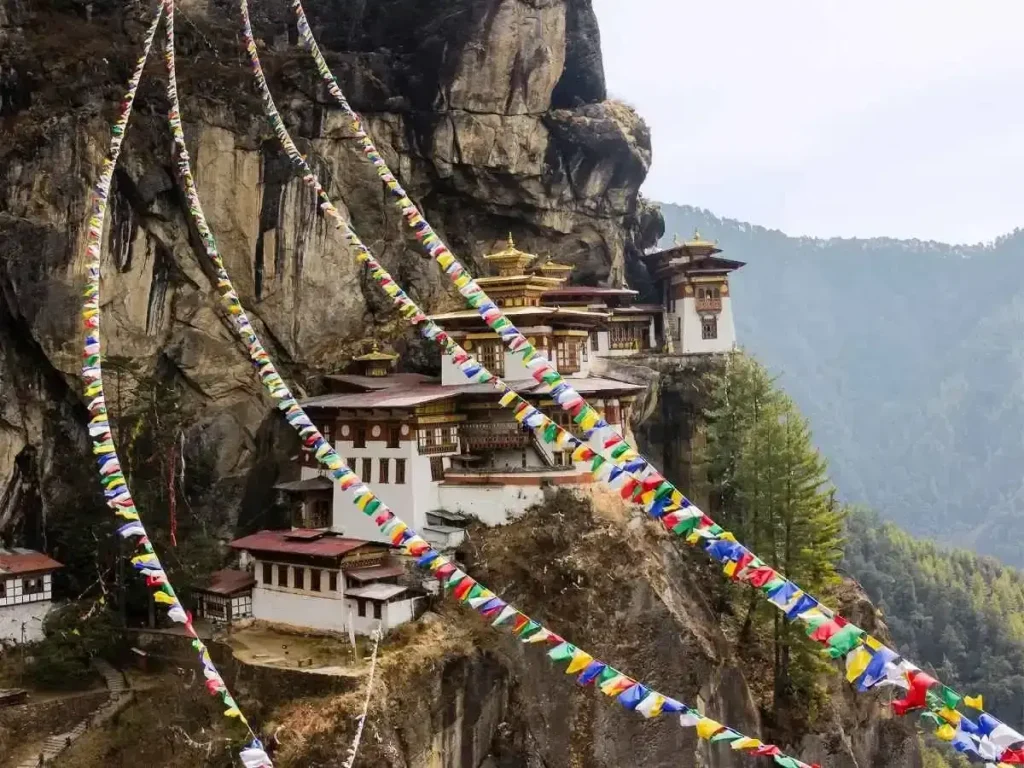
The cliff monastery above Paro.
Itinerary at a glance
Nine days at a glance
Workshop days can be extended if you want more time painting.
Day 1: Arrive in Paro
Land in Paro.
Day 2: To Thimphu, Zorig Chusum
The National Institute for Zorig Chusum.
Day 3: Workshop day one
Drawing on the proportion grid.
Day 4: Workshop day two
Pigments and painting.
Day 5: Thimphu crafts
Woodcarving, masks and papermaking.
Day 6: To Punakha
Over Dochula to Punakha Dzong.
Day 7: Back to Paro
Drive to Paro, Kyichu Lhakhang.
Day 8: Tiger's Nest
Hike to Paro Taktsang.
Day 9: Depart
Transfer to Paro airport.
Day 1
Arrive in Paro
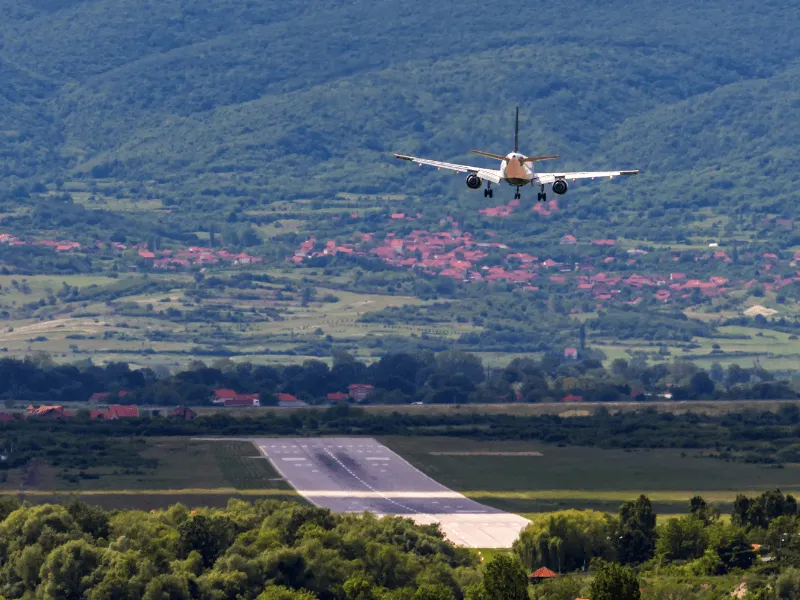
Your guide meets you at Paro airport. After lunch you visit the National Museum in the Ta Dzong, which has fine old thangkas, and walk down to Rinpung Dzong, whose galleries are painted with the wheel of life and other classic subjects. Your guide explains how to read the images.
- Overnight: Paro
- Altitude: about 2,200 metres
- Meals: lunch and dinner
Day 2
The thirteen arts
You drive to Thimphu and spend the afternoon at the National Institute for Zorig Chusum, moving between classrooms to watch students draw on proportion grids, paint thangkas, carve wood, sculpt clay and embroider. You can buy work made by the students at the institute shop.
- Overnight: Thimphu
- Drive: about 1.5 hours
- Meals: breakfast, lunch and dinner
Day 3
In the painter's studio
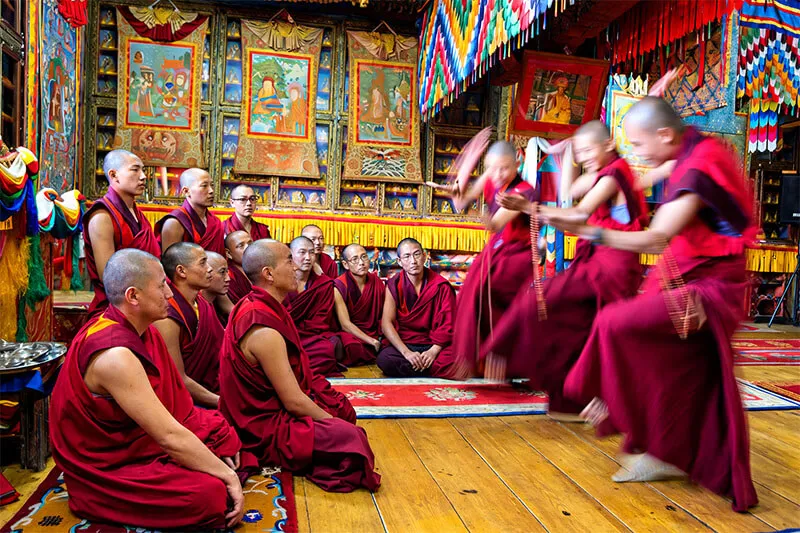
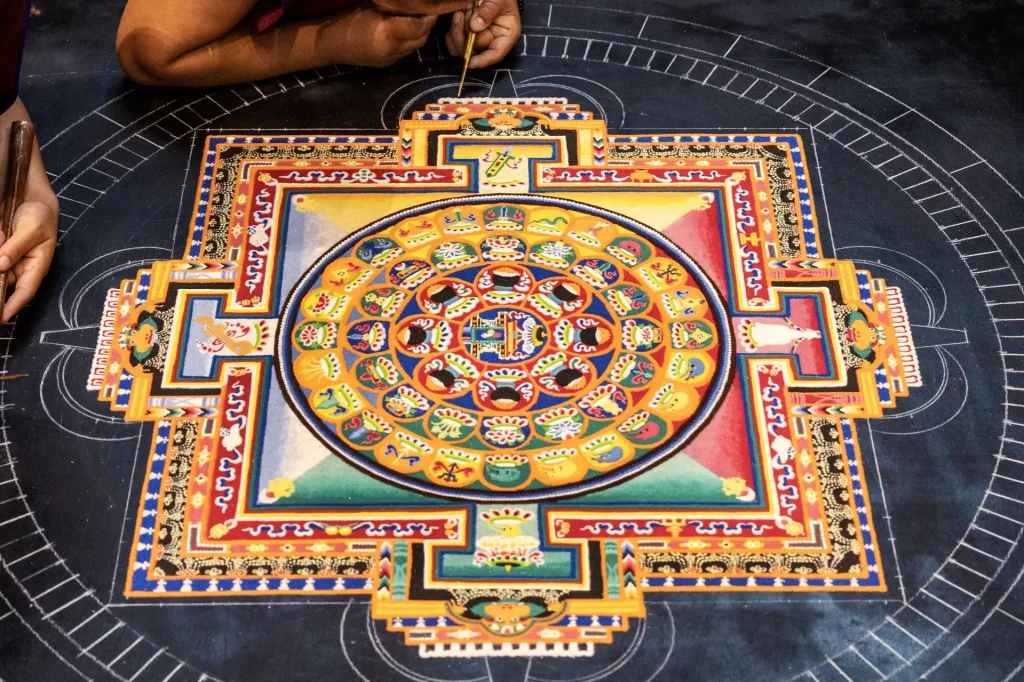
You spend the day in a thangka painter’s studio. The master explains the iconometric grid that fixes the proportions of every figure, and you practise drawing a Buddha’s face and body in charcoal and then ink. You also learn how the cotton canvas is stretched and primed with gesso and polished smooth.
- Overnight: Thimphu
- Workshop: about 5 hours
- Meals: breakfast, lunch and dinner
Day 4
Colour and gold
On the second day you learn how pigments are ground from minerals and mixed with binder, how colours are applied in layers from light to dark, and how gold is used for the finishing lines. You paint a small piece, a lotus, a cloud or a simple figure, to take home, and the master adds the final touches.
- Overnight: Thimphu
- Workshop: about 5 hours
- Take home: your own painting
Day 5
Carvers, mask makers and paper
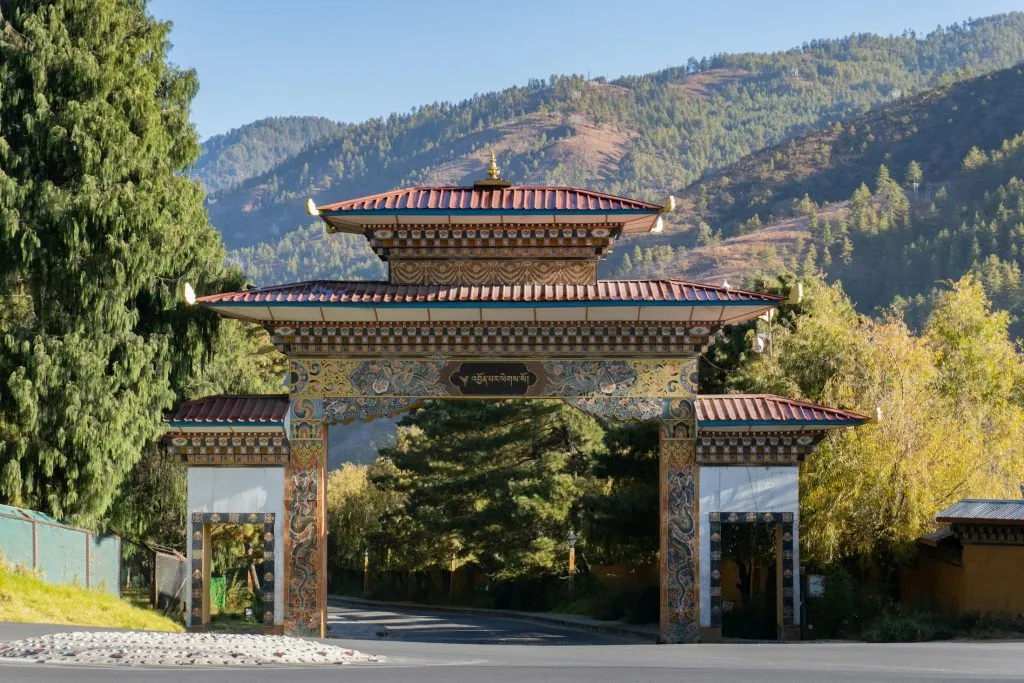
You visit a woodcarving workshop, where craftsmen carve the window frames and altar pieces of Bhutanese buildings, and a mask maker, who carves and paints the masks used in cham dances. In the afternoon you visit the traditional paper factory to see deh-sho paper made from daphne bark, and the craft bazaar.
- Overnight: Thimphu
- Visits: three workshops
- Meals: breakfast, lunch and dinner
Day 6
The murals of Punakha
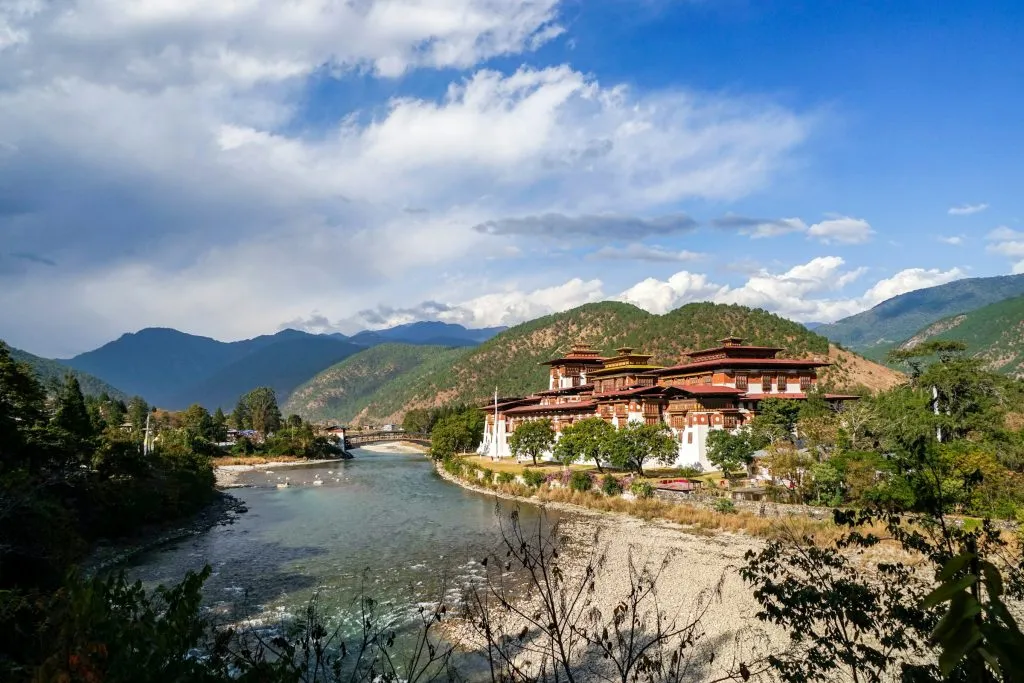
You cross Dochula, where the murals of Druk Wangyal Lhakhang show modern events in the traditional style, and visit Punakha Dzong, built in 1637, whose temples hold some of the most beautiful paintings in Bhutan. You walk to Chimi Lhakhang through rice fields.
- Overnight: Punakha
- Drive: about 3 hours
- Walk: about 1 hour
Day 7
Back to Paro
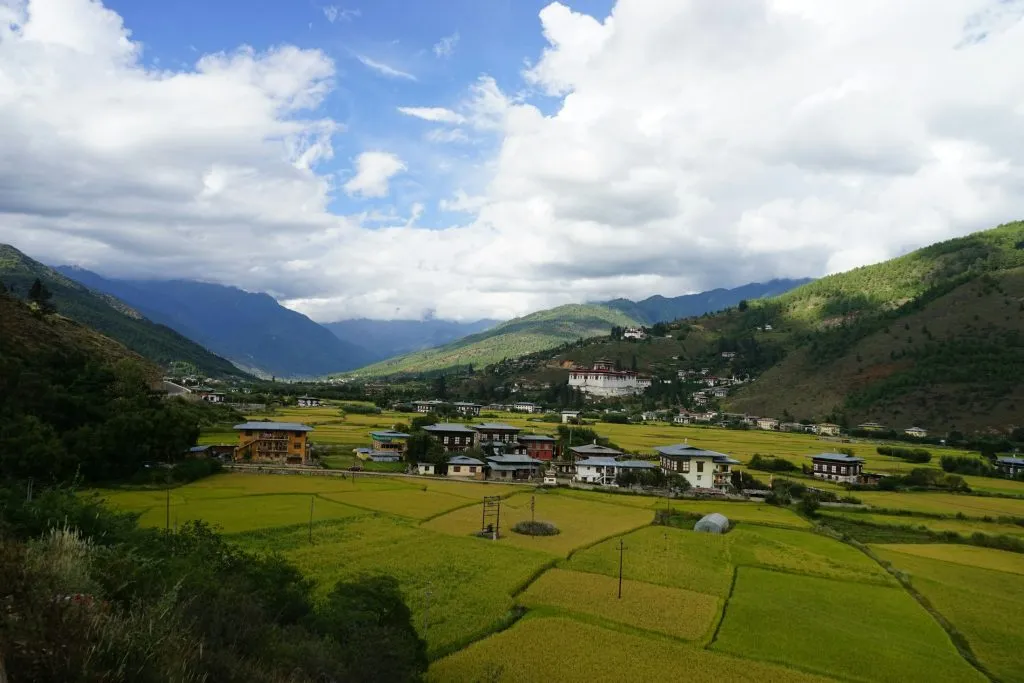
You drive back over Dochula to Paro and visit Kyichu Lhakhang, one of Bhutan’s oldest temples, and Dungtse Lhakhang, a chorten-shaped temple with remarkable murals, if it is open. In the evening you can book a hot stone bath.
- Overnight: Paro
- Drive: about 4.5 hours
- Optional: hot stone bath
Day 8
Hike to the Tiger's Nest
The hike to Paro Taktsang, the Tiger’s Nest, takes five to six hours return. The path climbs through blue pine forest to a cafeteria with a clear view of the monastery, then on to the cliff itself at about 3,120 metres, where Guru Rinpoche is said to have meditated in the 8th century.
- Overnight: Paro
- Hike: 5 to 6 hours return
- Altitude: about 3,120 metres
Day 9
Fly home
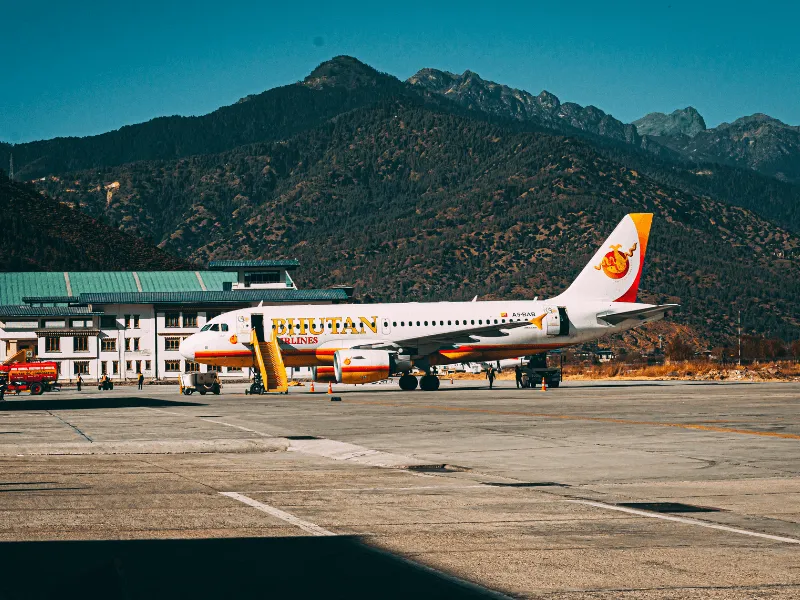
After breakfast your guide drives you to Paro airport for your flight home.
- Transfer: about 15 minutes
- Meals: breakfast
Where you stay
Where you stay
Comfortable hotels throughout.
| Nights | Place | Where you stay | Why we chose it |
|---|---|---|---|
| 1, 7 and 8 | Paro | 3-star or 4-star hotel | Luxury upgrades available |
| 2 to 5 | Thimphu | 3-star or 4-star hotel | Close to the studio |
| 6 | Punakha | 3-star or 4-star hotel | Valley views |
Longer workshops can be arranged with extra nights in Thimphu.
What the price covers
Included and not included
Included
- Bhutan visa (USD 40) and the Sustainable Development Fee for every night
- Hotels as listed, 3-star as standard, with 4-star and luxury upgrades on request
- All meals: breakfast, lunch and dinner
- A licensed English-speaking guide for the whole trip
- Private car or SUV with a Bhutanese driver, and all transfers
- Entry fees to dzongs, temples and museums
- Bottled water in the car
- Two-day thangka workshop with a professional painter, including materials
- Craft workshop visits
Not included
- International flights into and out of Paro (we can book them for you)
- Travel insurance, which we strongly recommend
- Drinks, laundry and other personal costs
- Tips for your guide and driver
- Anything not listed under included
- Thangkas and crafts you buy
Price on request
Tell us your budget and we will send our best price
We don’t publish one fixed price, because hotels, season and group size change the total a lot. Tell us your dates, who is travelling and the budget you have in mind. We will reply within 24 hours with our best price for this thangka painting and crafts tour.
How we price
What decides the cost of this trip
Government fees
The SDF is USD 100 per adult per night until 31 August 2027, plus a USD 40 visa. These are fixed by the Government of Bhutan and paid through us.
Hotels you choose
Group size, the length of the workshop and hotel style change the total most.
Season and dates
Spring and autumn are peak season. Winter and summer dates are often easier to price well.
Group size
Guide and car costs are shared, so the price per person drops for two, three or four travellers.
We send a written, itemised quote before you pay anything. No booking fees.
Good to know
Thangka painting in Bhutan
How a thangka is made
The painter stretches cotton cloth on a frame, coats it with a mix of chalk and glue, and polishes it smooth. The figure is drawn on a grid of lines that fixes its proportions, then outlined in ink. Colours are applied flat, then shaded, with gold added at the end. A large thangka can take months. When it is finished, it is mounted in brocade and consecrated by a lama before it is hung.
Buying a thangka
Prices depend on size, detail, the pigments used and the painter’s skill. Ask the seller who painted it and where. Mineral pigments and real gold cost more than acrylics. Your guide can take you to reliable studios and to the institute shop. New thangkas can be taken home freely; old ones cannot be exported.
Respect in temples
Photography is not allowed inside temples and dzong shrine rooms, so the finest paintings must be seen, not photographed. Walk clockwise around temples, do not point at images with one finger, and do not touch the paintings. Your guide will explain the subjects as you go.
The thirteen traditional arts
Bhutan groups its traditional crafts as zorig chusum, the thirteen arts. They are painting, sculpture, wood carving, calligraphy, papermaking, bronze casting, woodturning, blacksmithing, ornament making, bamboo and cane work, weaving, embroidery and tailoring, and masonry and carpentry. The government supports them through the National Institute for Zorig Chusum in Thimphu and the College of Zorig Chusum in Trashi Yangtse, where young people train for four to six years.
Buying crafts and taking them home
Buy from cooperatives, craft bazaars and the artisans themselves where you can, so more of the money stays with the maker. Prices in government-run shops are fixed; in markets a little friendly bargaining is fine. Bhutan does not allow the export of antiques or old religious objects, so be wary of anything sold as old. New thangkas, textiles, masks and wooden bowls can be taken home freely. Keep your receipts in case customs ask.
Temple etiquette
Cover shoulders and knees in dzongs and temples, take off hats, and walk clockwise around chortens and prayer wheels. Photography is not allowed inside shrine rooms. Your guide explains each place before you go in. Read more in our Bhutan travel rules guide.
Visa, SDF and guide rules
Every visitor except Indian nationals needs a visa, which costs USD 40 and is issued online before you fly. The Sustainable Development Fee is USD 100 per adult per night until 31 August 2027, with half rates for children aged 6 to 11. A Department of Tourism notice from April 2026 confirms that visitors travel with a licensed guide. We file the visa and pay the SDF for you. Read more in our Bhutan visa guide and SDF guide.
Flying into Paro
Only Drukair and Bhutan Airlines fly into Paro, mainly from Bangkok, Delhi, Kathmandu, Kolkata and Singapore. Pilots land by sight between the ridges, so morning flights are the most reliable. We suggest a night in your hub city on the way in. Our flights to Bhutan page lists every route.
Thangka painting tour: questions
It depends on your hotels, group size and dates. Tell us your budget and we will reply within 24 hours with our best price, including the SDF, visa, hotels, meals, guide and car.
No. The master adjusts the lesson to your level.
Yes, the small piece you paint during the workshop.
Yes. We can add days in Thimphu for a longer course.
The thirteen traditional arts of Bhutan, including painting, carving and weaving.
Yes. It is open to visitors on weekdays during term.
Yes, from studios and the institute shop. Old thangkas cannot be exported.
Two to four months ahead.
Price on request
Ask for your best price
Tell us your dates, your painting experience and your budget. We will reply within 24 hours with our best price for this thangka painting and crafts tour.
- Share your budget, we shape the trip around it
- No booking fees, ever
- A reply within 24 hours
- Licensed Bhutanese tour operator
- +975 17533776
- +975 77495028
- info@deyabhutantours.com
- Thimphu, Bhutan
Let's plan your Bhutan journey
Tell us a little about your trip. Our team in Thimphu will reply with ideas, a day-by-day plan and a full price.
We’ll reply within 24 hours. No booking fees, and no obligation to book.