- Licensed Bhutanese tour operator
- Thimphu, Bhutan

Blog · Updated November 2026
Flying into Bhutan: 12 facts about Paro airport and the flight in
The landing at Paro is one of the most talked-about approaches in aviation. Here is what really happens on the way in, which airlines fly there, where to sit for the mountains, and how to book so your trip starts on time.
- Paro airport at 2,235 m
- Daylight flights only
- Updated for 2027
2,235 m
Altitude of Paro airport
About 50
Pilots reported as certified to land
2
Airlines fly into Bhutan
Daylight
Paro has no night landings
Before you fly
Why the flight is part of the trip
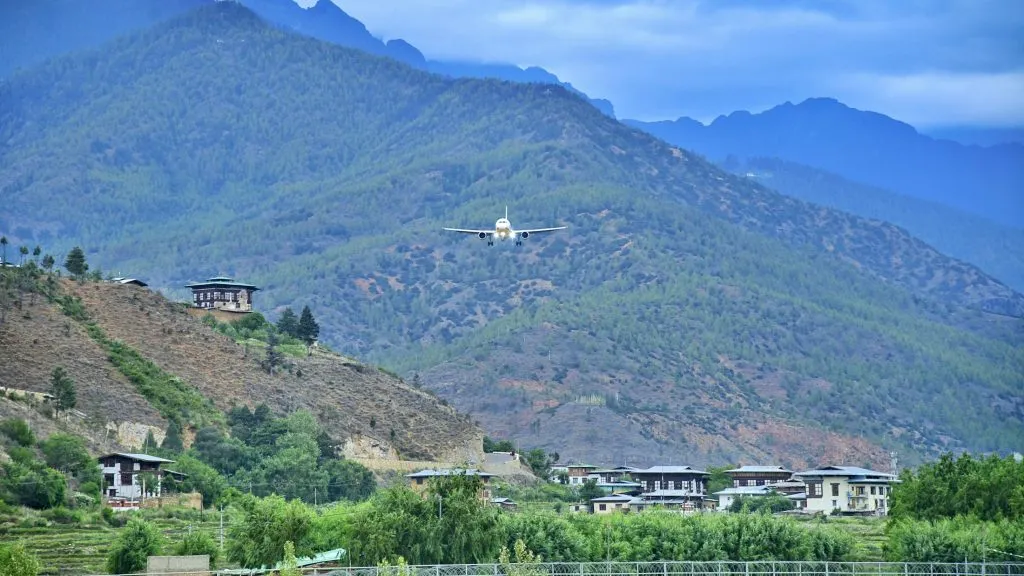
Most international trips start with a long, forgettable flight. Bhutan is different. Paro, the country’s only international airport for most travellers, sits in a narrow river valley with forested ridges close on both sides. There is no straight-in approach. Pilots fly down the valley, bank around the hills and line up with the runway only in the last moments, while you look out at farmhouses, prayer flags and Rinpung Dzong.
You may have read that only eight pilots in the world can land at Paro. That figure has circulated for years, but it is out of date. Recent reports put the number of pilots certified for Paro at around fifty, almost all flying for Bhutan’s two airlines. The point behind the old claim still stands: landing here takes special training, local knowledge and good weather.
Below are twelve facts about flying into Bhutan, followed by the routes, the best seats and the practical steps that keep your arrival smooth.
- Only Drukair and Bhutan Airlines fly into Bhutan
- Flights operate in daylight and in good visibility
- Your visa clearance is checked before you board
The facts
12 facts about flying into Bhutan
1. Paro airport sits 2,235 metres above sea level
That is about 7,330 feet, higher than many ski resorts. The thinner air affects how aircraft climb and brake, so take-off weights and runway performance are calculated carefully on every flight. The runway itself is about 2,265 metres long, short by international standards.
2. The surrounding peaks reach well above 5,000 metres
The Paro valley is ringed by ridges, and higher mountains rise beyond them. On a clear day you can see snow on the peaks to the north as you come in. This terrain is why Paro is treated as one of the most demanding airports in the world.
3. Pilots need special certification
Paro is classed as a Category C airport, which means pilots must train specifically for it, usually with a qualified captain on board and in a simulator, before they can land there themselves. Reports put the number of certified pilots at around fifty. The often-repeated figure of eight is an old claim and no longer accurate.
4. The approach is flown by sight
Landings at Paro are made visually, with the pilots following the valley rather than a long straight instrument approach. The final turn comes close to the hillside, and passengers on the right side often see houses and trees surprisingly near the wingtip. It feels dramatic, but it is a routine, well-practised procedure for the crews who fly it.
5. There are no night landings
Flights to and from Paro operate in daylight only. Most international flights arrive in the morning or early afternoon, before afternoon winds and cloud build up. If weather closes in, flights wait or turn back rather than take chances, which is why we always plan a buffer around your Paro flights.
6. Only two airlines fly into Bhutan
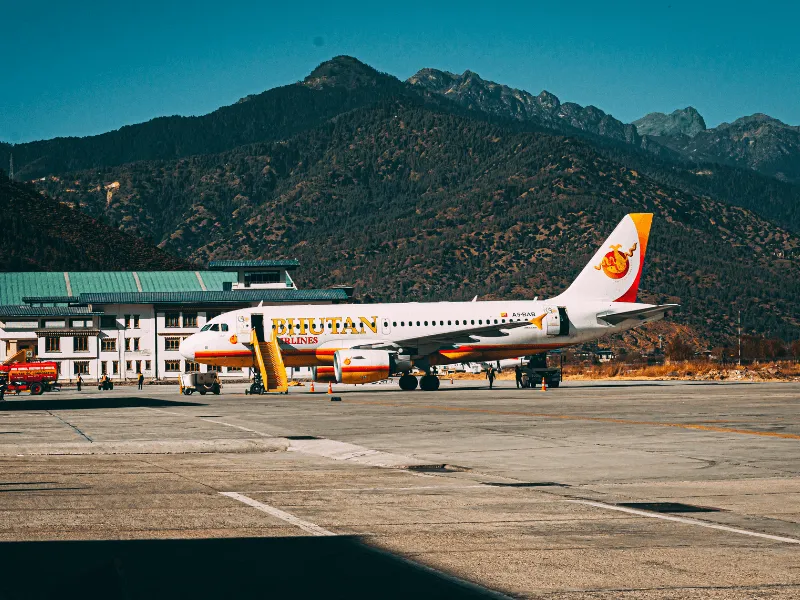
Drukair, the national airline, was founded in 1981 and flew its first commercial service in 1983. Bhutan Airlines, the privately owned carrier, started flying in 2011. Both fly Airbus A319 and A320 family jets on international routes, and Drukair uses ATR turboprops on domestic routes.
7. You can see Everest on the way in
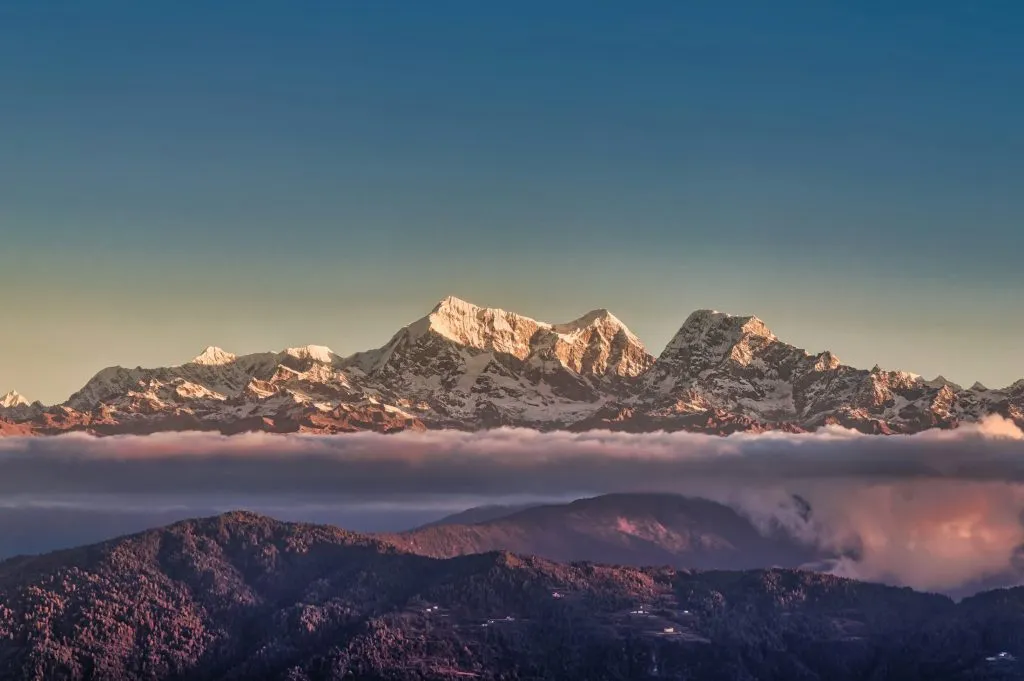
On the Kathmandu to Paro flight, the plane follows the Himalaya east and passes Everest, Lhotse, Makalu and Kanchenjunga on a clear day. Ask for a seat on the left side of the aircraft when flying from Kathmandu or Delhi to Paro. On the way out, sit on the right.
8. You walk across the tarmac
There are no jet bridges at Paro. You walk down the steps onto the apron and across to a terminal built in traditional Bhutanese style, with painted wooden windows and roof details. Many travellers say this is the moment the trip really begins.
9. Immigration is quick and quiet
Paro is a small airport, and arrivals usually move fast. You show your passport and the visa clearance letter we send before your trip, and your visa is stamped on arrival. Your guide waits outside with a white scarf or a name board.
10. Bhutan has other airports too
Domestic flights link Paro with Bumthang (Bathpalathang airport) in central Bhutan and Yonphula near Trashigang in the east. Gelephu in the south has also had international flights to Kolkata since December 2025, as part of the plans for Gelephu Mindfulness City.
11. Flights are limited, so seats sell out
With two small airlines and a handful of routes, the number of seats into Paro is limited. In March, April, October and November, and around big festivals such as Paro and Thimphu Tshechu, flights can fill months ahead. Booking Paro flights early matters more than booking your long-haul ticket early.
12. You cannot board without your visa clearance
Airlines flying to Bhutan check your visa clearance before you board. That clearance is issued once your tour is booked through a licensed operator and the Sustainable Development Fee is paid. Indian, Bangladeshi and Maldivian nationals have different entry rules and do not need a visa clearance of the same kind.
Routes
Where you can fly to Paro from
| From | Airline | How often | Good to know |
|---|---|---|---|
| Delhi | Drukair and Bhutan Airlines | Daily | The main link for Europe and North America |
| Kathmandu | Drukair and Bhutan Airlines | Daily | The Himalayan view flight, easy to add Nepal |
| Bangkok | Drukair and Bhutan Airlines | Several a week | Some Drukair flights are direct, others stop in Bagdogra or Guwahati |
| Singapore | Drukair | Three a week | Stops briefly in Guwahati |
| Kolkata | Drukair and Bhutan Airlines | Several a week | Some Drukair flights route via Gelephu |
| Dhaka | Drukair | Twice a week | Handy for Bangladesh travellers |
| Gaya | Drukair | Twice a week | For Bodh Gaya pilgrims |
| Dubai | Drukair | Twice a week | Check the current season, as this route has been suspended before |
Based on Drukair’s published December 2026 schedule and Bhutan Airlines’ regular routes. Schedules change by season, so we confirm flights for your exact dates.
Booking tips
How to book your flights to Bhutan
Book Paro seats first
Agree your Bhutan itinerary, hold the Paro flights, and only then buy your long-haul ticket to match.
Add a buffer night
A night in Delhi, Bangkok or Kathmandu protects your trip if a long-haul flight runs late.
Pick the left side
Flying into Paro from Kathmandu or Delhi, a left-side window seat gives the best mountain views.
Pack light
Regional flights have tighter baggage rules than long-haul ones. Check your allowance before you fly.
Carry your documents
Keep your visa clearance letter, passport and onward ticket together. Airlines ask for them at check-in.
Expect weather changes
Morning flights are the most reliable. In the monsoon, delays happen, so leave time on the way out.
On arrival
What happens after you land
Once you are through immigration and have your bags, you walk out to a small arrivals area where your guide and driver are waiting. Most guests are welcomed with a white khadar scarf, a traditional greeting.
From Paro it is about an hour’s drive to Thimphu, or a few minutes to a hotel in the Paro valley. Many itineraries start gently in Paro or Thimphu to help you adjust to the altitude before longer drives over the passes.
You do not need local currency on arrival, since your hotels, meals, guide and transport are already arranged. Ngultrum and Indian rupees are both used, and you can change money or use ATMs in Paro and Thimphu.
- Guide and driver meet you at arrivals
- About one hour's drive to Thimphu
- No need to change money at the airport
Leaving Bhutan
Flying out of Paro
Departure flights also leave in the morning. Your guide will drive you to the airport about two hours before the flight, help with check-in, and say goodbye at the door. Paro’s small terminal has a café and a few craft shops. Keep your boarding pass handy, as there are separate security checks for bags and passengers.
Connecting to your flight home
If your onward long-haul flight is on a separate ticket, leave plenty of time in Delhi, Bangkok or Kathmandu. A same-evening connection works on most days, but a night in the hub city is the safer choice in the monsoon or in winter, when fog can delay flights in northern India.
From your seat
What the landing feels like
The descent starts well before you see the runway. On flights from Delhi or Kathmandu the plane drops out of the high cloud over the foothills, and the ground below changes from plains to folded green ridges. Then the cabin crew ask you to fasten your seat belt, and the turns begin.
Expect two or three steady banks as the aircraft follows the valley. Through the window you will see terraced fields, white farmhouses with painted windows and, for a moment, the long walls of Rinpung Dzong above the Paro Chhu river. The engines change pitch as the pilots slow down, the last turn lines you up, and the wheels touch down shortly after. The braking is firm because the runway is short.
Nervous flyers sometimes worry about this part. It helps to know that the crews fly this approach many times a month, and that a flight simply does not go ahead if the weather is wrong. Most passengers spend the descent with a phone pressed to the window, and quite a few clap on landing.
Photography on the flight
You can take photographs from your seat through the window, but follow crew instructions during take-off and landing, and keep your phone in flight mode. On the apron, take pictures of the terminal and the mountains, but do not photograph security areas, and ask before taking pictures of staff. A polarising filter helps cut window glare if you shoot with a camera.
Altitude
Your first day at 2,235 metres
Paro and Thimphu sit at roughly 2,200 to 2,400 metres. Most healthy travellers feel fine, but some notice a mild headache, short breath on stairs or a poor first night’s sleep. These usually pass within a day or two.
Take the first afternoon slowly. Drink plenty of water, go easy on alcohol, and save the Tiger’s Nest hike for later in your trip, after a couple of nights at this height. If you are coming from sea level and have a heart or lung condition, speak to your doctor before you travel.
Our itineraries are planned with this in mind. The hardest walks come after you have spent time in the valleys, and the high passes such as Chele La (about 3,988 m) are visited as day trips rather than overnight stops early in the trip.
- Drink water and rest on day one
- Hike Tiger's Nest after a few nights
- Ask your doctor if you have a heart or lung condition
Inside Bhutan
Domestic flights and other ways in
Flying to Bumthang and the east
Drukair runs domestic flights from Paro to Bathpalathang in Bumthang and to Yonphula near Trashigang. A flight to Bumthang takes about half an hour and saves a full day of driving over three high passes, which makes it useful on longer cultural trips or if you want to see eastern Bhutan without driving both ways. Domestic flights are small and can be cancelled in poor weather, so we always keep a driving plan ready.
Entering by road
You do not have to fly. Travellers can enter by land from India at Phuentsholing, opposite Jaigaon in West Bengal, and at Samdrup Jongkhar in the south-east and Gelephu in the south. Phuentsholing is about five to six hours’ drive from Thimphu. Many visitors fly in to Paro and leave by road, or the other way round, which avoids retracing their route.
Helicopter flights
Bhutan has a small helicopter service used for medical evacuation and charter. Charters for sightseeing or quick transfers to remote areas can sometimes be arranged, subject to weather and permits. Ask us if you want to look into it.
Flying into Bhutan: questions
Yes. Paro is demanding, but only specially trained pilots fly there, flights run in daylight and in good visibility, and both airlines have long safety records on the route.
Recent reports put the number at around fifty. The old claim that only eight pilots can land there is out of date.
Drukair, the national airline, and Bhutan Airlines, a private carrier. No other airline flies into Bhutan.
No. Fly to Delhi, Bangkok, Kathmandu or Singapore and connect to Paro.
Sit on the left side when flying from Kathmandu or Delhi to Paro, and on the right side when flying out.
Yes, for most nationalities. You need a visa clearance letter, which we arrange once your tour is booked. Airlines check it at check-in.
Yes, mainly by weather. Morning flights are the most reliable, and we build a buffer around your Paro flights.
Let us book your Paro flights with your tour
Tell us where you are flying from and when. We will hold Drukair or Bhutan Airlines seats that match your itinerary and suggest the best connection.