- Licensed Bhutanese tour operator
- Thimphu, Bhutan

Blog · Updated November 2026
Paro Tshechu: a first-timer's guide to Bhutan's spring festival
Five days of masked dances in the courtyard of Rinpung Dzong, with the whole valley dressed in its best clothes. This guide covers what you will see, what to wear, how a festival day works and how to plan your trip.
- Five days in spring
- Tentatively 18 to 22 March 2027
- Dawn thongdrel on the last day
5 days
Of dances at Rinpung Dzong
Dawn
When the thongdrel is unrolled
2nd month
Of the Bhutanese lunar calendar
Free
No festival ticket, but tours must be booked
The festival
What Paro Tshechu is
A tshechu is a religious festival held in honour of Guru Rinpoche, the eighth-century teacher who brought Vajrayana Buddhism to Bhutan. Tshechu means “tenth day”, and the main days fall around the tenth day of a lunar month. Almost every district holds one, but Paro’s is among the biggest and best known.
It takes place each spring at Rinpung Dzong, the fortress above Paro town. For five days monks and lay dancers perform cham, sacred masked dances, in the dzong’s courtyard and on the festival ground below. Families come from across the valley and beyond, dressed in their finest gho and kira, carrying picnics and meeting friends they may not have seen since last year.
For Bhutanese people the festival is a blessing. Watching the dances is believed to bring merit and to clear away negative actions. For visitors it is the clearest window into living Bhutanese faith you can find, and a brilliant social occasion too.
- Held in honour of Guru Rinpoche
- Sacred masked dances called cham
- Tentatively 18 to 22 March 2027
On the day
What to expect at Paro Tshechu
The setting
The first day’s dances are usually held inside the dzong courtyard, a smaller space with a close, intense atmosphere. On the following days the festival moves to the open ground below the dzong, where there is more room for the crowd. The audience sits on the steps and the grass around the dance ground, with the dzong walls behind and the hills of the Paro valley beyond.
The dances
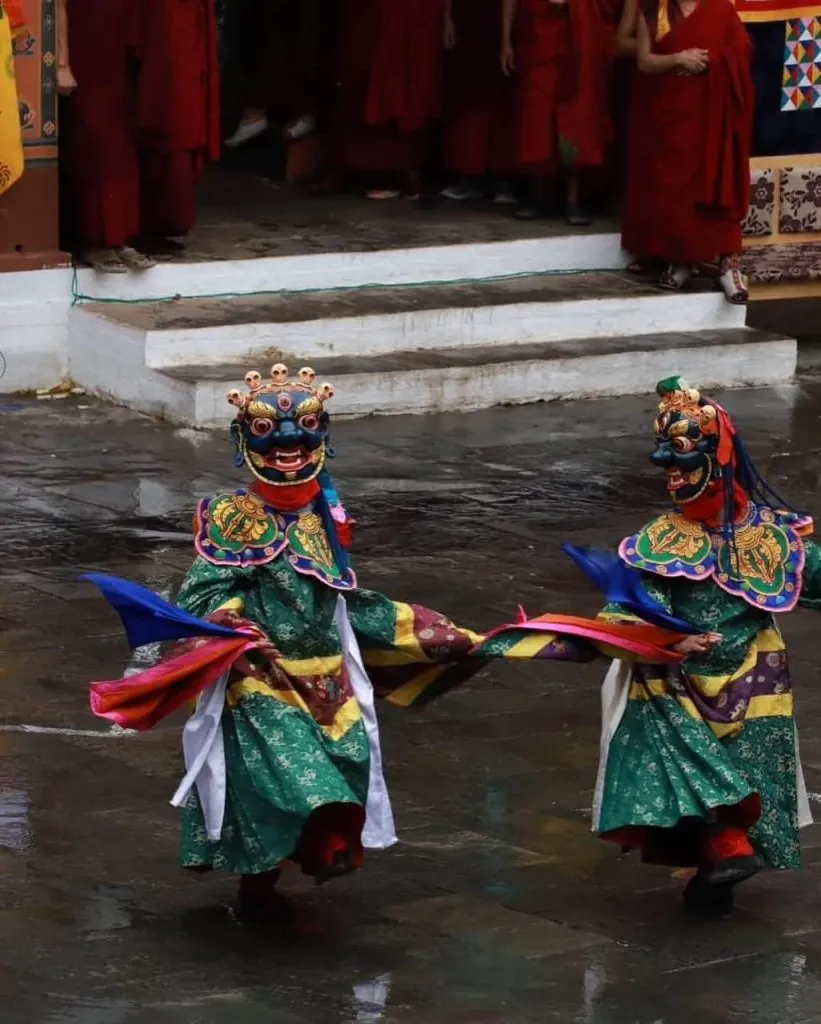
Each dance has a meaning, often a story about Guru Rinpoche, a lesson about death and rebirth, or the defeat of forces that harm the teachings. Dancers wear heavy brocade robes and painted wooden masks of deities, animals and demons, and they move to the sound of long horns, cymbals and drums. Some dances are slow and stately. Others whirl and leap. Among the dances commonly performed at Paro are the Dance of the Lords of the Cremation Grounds, the Dance of the Terrifying Deities, the Dance of the Noblemen and Ladies, and the Dance of the Three Kinds of Ging.
The atsaras
Between the dances you will see the atsaras, masked clowns with long red noses who tease the crowd, mimic the dancers and crack jokes, some of them quite rude. They are not just entertainment. Atsaras are said to represent the acharyas, religious teachers, and they keep order in the crowd as well as making it laugh. Expect to be teased if you stand too close with a camera.
The thongdrel at dawn
On the last morning, well before sunrise, a huge thangka is unrolled on the wall above the festival ground. This is the thongdrel, a giant religious painting of Guru Rinpoche, and seeing it is believed to free the viewer from the cycle of rebirth. It is shown for only a few hours and rolled up again before the sun touches it. Thousands of people climb up in the dark to receive the blessing. If you can manage one early start in Bhutan, make it this one.
The crowd
The audience is as much part of the experience as the dancers. Grandmothers spin prayer wheels, children chase each other around the edge of the ground, and young people show off new clothes. People share food and butter tea. Your guide will help you find a good spot and explain what is happening in each dance.
Five days
How the Paro Tshechu days usually run
| Day | Where | What happens |
|---|---|---|
| Day 1 | Inside Rinpung Dzong | Opening dances in the courtyard, smaller and more intimate |
| Days 2 to 4 | Festival ground below the dzong | Full programme of masked dances, atsaras between dances, big crowds |
| Day 5, before dawn | Wall above the festival ground | The thongdrel is unrolled and blessings are received |
| Day 5, daytime | Festival ground | Final dances, then the festival closes |
This is the usual pattern. The exact order of dances can change from year to year. The 2027 dates are the Department of Tourism’s tentative dates and should be confirmed closer to the time.
Etiquette
What to wear and how to behave
Dress smartly
Long sleeves, long trousers or a long skirt, and closed shoes. Many visitors wear a gho or kira for the day, and locals appreciate it.
Hats off in the dzong
Remove hats and sunglasses when you enter the dzong and when the most sacred dances are performed.
Photograph with care
Photography is generally allowed in the open courtyard, but never use flash, never walk onto the dance ground and do not block the view of people sitting behind you.
Sit where you are shown
Some areas are kept for officials, monks or elders. Your guide will show you where visitors can sit.
Respect the ritual
These are religious ceremonies. Keep your voice down during dances and do not point your feet at the dancers or altars.
Join in gently
If a local family offers you food or tea, accept with your right hand. A smile and a "kadrinchey" (thank you) goes a long way.
Planning
How to plan a Paro Tshechu trip
Paro Tshechu is one of the busiest weeks of the year in Bhutan. Hotels in Paro and Thimphu fill early, and so do the flights into Paro. Plan six to nine months ahead if you can, and book your Paro flights as soon as your tour dates are fixed.
You do not need to watch all five days. Most visitors spend one or two days at the festival and the rest of the trip exploring. A good plan is to attend one full day on the festival ground and the dawn thongdrel on the last morning, and to fit in the Tiger’s Nest hike, Thimphu and Punakha around them.
Spring is also a lovely time to travel in general. Rhododendrons start to flower on the passes, the weather is mild and fruit trees blossom in the valleys.
- Book 6 to 9 months ahead
- One or two festival days is enough for most visitors
- Plan the thongdrel morning as a priority
Sample plan
A 6-day trip built around Paro Tshechu
A simple plan that gives you the festival without spending the whole week at it. Our full tour is linked below.
Day 1: Arrive in Paro
Land in Paro, then drive to Thimphu for two nights.
Day 2: Thimphu
Buddha Dordenma, Tashichho Dzong, the weekend market and craft centres.
Day 3: Back to Paro
Return to Paro and spend the afternoon at the festival ground.
Day 4: Paro Tshechu
A full day of dances with your guide explaining each one.
Day 5: Thongdrel and Tiger's Nest
Dawn thongdrel, a rest at the hotel, then a later start for Taktsang or a valley walk.
Day 6: Depart
Transfer to Paro airport.
Practical tips
Small things that make the day better
Bring a light cushion or foldable mat, as you will sit on stone steps or grass for hours. Pack sunscreen and a hat for the open ground, since the spring sun is strong at 2,200 metres, and a warm layer for the early thongdrel morning, which can be close to freezing.
Carry water and some snacks, though food stalls around the festival ground sell momos, tea and sweets. Toilets are basic, so keep tissue and hand sanitiser in your bag. Cash is useful for small purchases at the stalls.
Arrive early on the main days to get a good spot, and agree a meeting point with your guide in case you get separated in the crowd. Above all, take time to put the camera down. Some of the best moments at a tshechu are quiet ones: an old woman’s prayer as a dancer passes, children laughing at an atsara, the smell of incense drifting over the crowd.
Paro or another tshechu?
Paro is a wonderful first festival, but it is busy. If you prefer smaller crowds, look at festivals held at the same time of year in other districts, such as Gasa, Talo near Punakha and Gomphu Kora in the east. Our 2027 festival calendar lists the dates for every district.
Getting around during festival week
Traffic in Paro is heavier than usual during the festival, and parking near the dzong is limited. Your driver will drop you close to the ground and collect you afterwards, so you do not need to worry about it. If your hotel is in the Paro valley, the drive is short. Guests staying in Thimphu should allow about an hour each way and start early on the main days. On the thongdrel morning we usually leave the hotel around 3.30 to 4 am, so plan an early night.
Background
Rinpung Dzong and the story behind the dances
The dzong
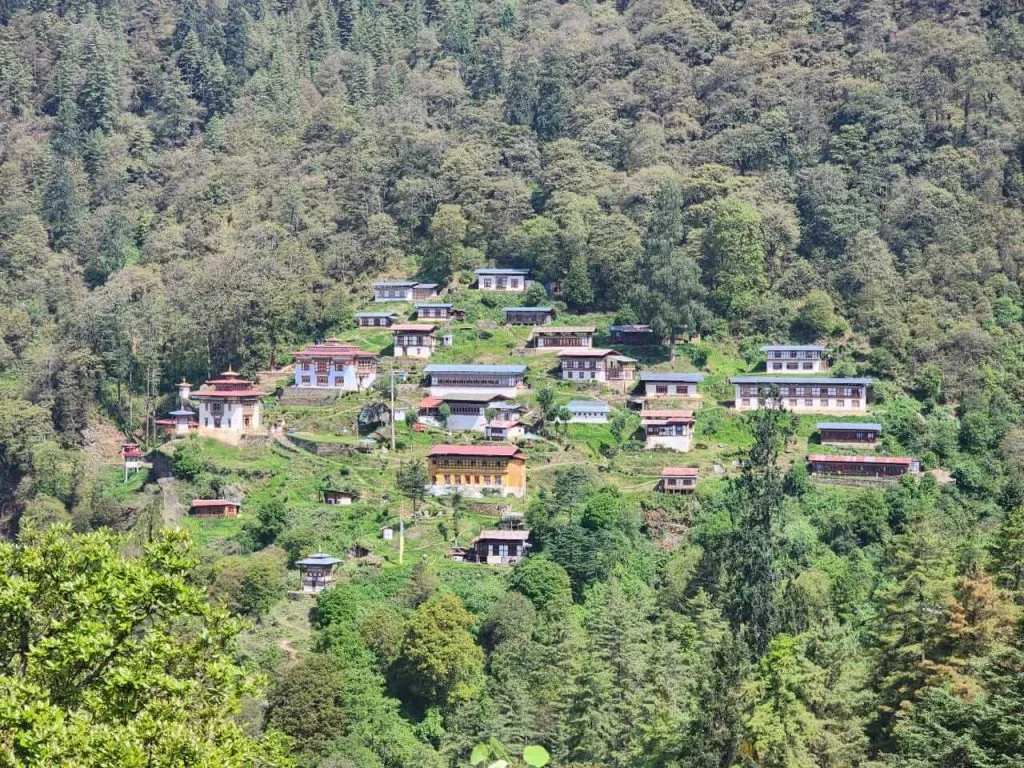
Rinpung Dzong, whose name means “fortress on a heap of jewels”, was built in the 1640s under Zhabdrung Ngawang Namgyal on the site of an older monastery. Like other dzongs, it combines a monastery with the offices of the district administration. A fire in 1907 destroyed much of the building, and it was restored soon after. One of its oldest treasures is the giant thongdrel shown at the festival. Below it, Nyamai Zam, a covered wooden cantilever bridge, crosses the Paro Chhu. Many visitors walk over it on their way to the festival.
Why the dances are performed
Many tshechu dances date back centuries, and some are said to have been composed by great Buddhist masters after visions. They are a form of teaching. People who cannot read scripture learn about compassion, death and the results of their actions by watching them. Some dances purify the ground, some show the defeat of harmful spirits, and some depict the eight manifestations of Guru Rinpoche, each with a different mask and a different character.
Who the dancers are
Dances are performed by monks of the dzong and by lay dancers, who train for weeks before the festival. The masks are heavy and the costumes thick, and dancers often perform for long periods in the spring sun. Watch their feet. The steps follow precise patterns handed down by teachers, and getting them right is part of the offering.
Before the festival
In the days before the public dances, monks perform rituals and rehearsals inside the dzong. Visitors are rarely allowed to watch these, but the sound of drums and horns from the dzong walls is a sign that the festival is close. In town, shops stock new clothes and families prepare food. If you arrive a day or two early, the build-up is fun to see.
Paro Tshechu: questions
The Department of Tourism’s tentative dates are 18 to 22 March 2027. Festival dates follow the lunar calendar and are confirmed closer to the time.
No. There is no festival ticket, but international visitors must travel on a booked tour with a licensed guide.
A giant thangka of Guru Rinpoche that is unrolled before dawn on the last day. Seeing it is believed to bring a great blessing.
Generally yes in the open areas, without flash and without entering the dance ground. Follow your guide’s advice for the most sacred dances.
Smart, modest clothes with long sleeves and long trousers or skirts. Wearing a gho or kira is welcome.
One or two days is enough for most visitors. Prioritise one full day of dances and the dawn thongdrel.
Plan your trip
Paro Tshechu dates and tours
Plan your Paro Tshechu trip early
Festival week fills fast. Tell us your dates and we will hold hotels and Paro flights and send our best price for your budget.